



One of the most common deficiencies seen in runners that results in compensation is what’s called a “hip drop.” A hip drop occurs when full body weight is being supported on one leg, like during the stance phase of running. Typically, a weakness in the hip of the weight-bearing leg causes the opposite hip to drop. This results in an increased angle of the pelvis and femur, causing muscles to compensate to continue the act of running. Compensation can be found pretty much anywhere in the body from the calf muscle to the knee, hip, and up to the back. It can occur on the same side or opposite side of the body. Basically, a weakness can wreak havoc on the body!
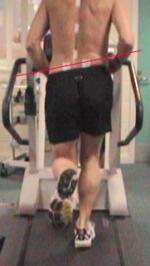
There are many exercises out there to strengthen the hips and the core. The key is to make sure you are doing the exercises properly and more importantly, make sure they are functional! Functional means that the strength you gain from doing them will turn over into strength that you can use while running.
What’s functional for running? Running takes place in an upright position and on a single leg. It involves bending our knees to absorb shock, then pushing off to propel us forward, over and over again. If we do all of our core and hip exercises either laying on our back or sitting on a machine, the strength gained from those exercises will do us very little good while we are actually running. Building up some strength on the floor initially is ok, but you are cheating yourself if you never challenge your functional core strength.
To make an exercise functional for running, it should be performed on a single leg and involve some degree of knee flexion. To address the problem of a hip drop, try the single-leg squat with a leg lift. Ideally, this exercise would be performed in front of a mirror so that you can correct any faulty movement when you see it.
Stand on a single leg on a weight bench, step, or box. Start the motion of a squat by “sticking your butt out.” This will cause your hip to hinge. As your hip hinges, your knee will start to bend. Continue to bend the knee as much as you can while maintaining proper form. Proper form means that your knee stays in line with your foot and your hips stay even with one another. If your knee starts to rotate inward, your hips are not doing their job properly. Only go as far into the squat as you can go with proper form. Continuing to do a full squat even though your knee is rotating in or your hip is dropping just strengthens the poor movement pattern that you have already been compensating with. You want to correct that movement pattern.


